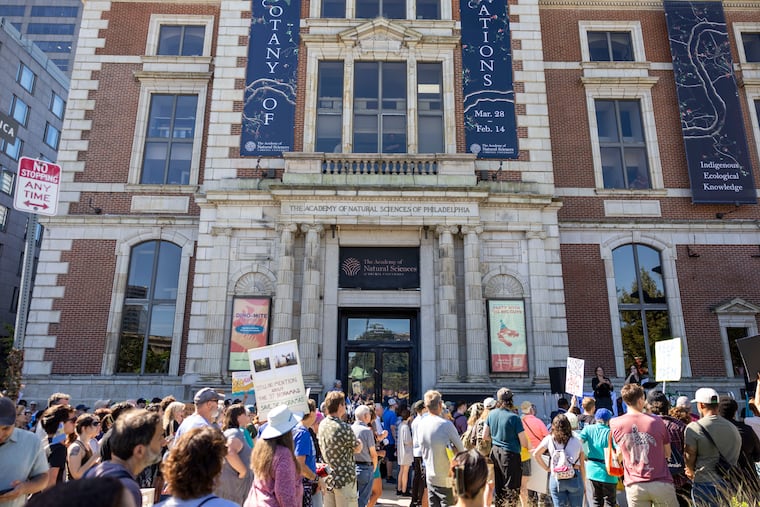
When Two Centuries of History Collide With Modern Realities: The Crisis at the Academy of Natural Sciences
If you take a step back and think about how fragile our cultural institutions really are, the unfolding saga between Drexel University and the historic Academy of Natural Sciences is a sobering wake-up call. Personally, I think we often fall into the trap of assuming that venerable landmarks—institutions that have stood for over two hundred years—possess some kind of permanent immunity against economic gravity. But what many people don't realize is that even the most celebrated repositories of human knowledge are perpetually walking a tightrope between heritage and financial survival.
What makes this situation particularly fascinating is how quickly a partnership built with the best of intentions can unravel when the cold, hard numbers refuse to cooperate. A detail that I find especially interesting is how the tension between institutional growth and preservation exposes the deep vulnerabilities facing modern museums everywhere. As negotiations continue behind closed doors, we are watching a slow-motion collision between academic ambition, public nostalgia, and the harsh economic realities of the post-pandemic cultural landscape.
The Anatomy of an Institutional Marriage That Hit the Rocks
When Drexel University and the Academy of Natural Sciences first joined forces back in 2011, the narrative was all about synergy and mutual rescue. In my opinion, university-museum partnerships are often romanticized as win-win scenarios, where academic heft props up public engagement while museums gain a stable operational safety net. Yet, if you look closer at how these arrangements actually play out, they frequently become exercises in mismatched expectations.
One thing that immediately stands out in this specific fallout is how a decade and a half of declining attendance—exacerbated brutally by the disruptions of COVID-19—can erode even a deeply embedded institutional bond. From my perspective, universities are fundamentally wired to look at bottom lines, strategic priorities, and fiscal resilience. When a museum partner struggles to regain its pre-pandemic visitor momentum—dipping from over 200,000 visitors down to roughly 126,000—the pressure to force a complete merger or pull the plug entirely becomes immense. This raises a deeper question about whether major universities are truly equipped to bear the weight of public heritage curation when their own operational mandates shift.
The Scramble for Lifelines and the 19-Million-Specimen Question
When news broke that the museum museum doors were closing and plans were being drawn up to relocate a staggering 19 million specimens, the public reaction was swift and fierce. Street protests, over 100,000 petition signatures, and looming City Council hearings prove that people still deeply care about these spaces. What this really suggests is a profound emotional disconnect between institutional decision-makers and the communities who view these natural history treasures as part of their collective civic identity.
A development that adds a layer of intricate drama here is the intervention by the William Penn Foundation, offering to step in with a temporary operational bridge. Personally, I find it telling how quickly corporate and foundation philanthropy is forced to act as an emergency room doctor for cultural institutions. However, as insiders have pointed out, short-term grants and temporary lifelines are often dismissed by institutional stakeholders as mere drops in the bucket against structural deficits. What people usually misunderstand about these rescue packages is that buying a few months of time doesn't fix a broken long-term business model; it only delays an inevitable, painful reckoning.
Looking Forward: What the Drexel-Academy Rift Teaches Us
If you look at the broader cultural horizon, the troubles in Philadelphia are part of a much larger, global identity crisis for natural history museums. In my opinion, the traditional model of relying on ticket sales, dioramas, and static exhibits is struggling to capture the attention of a digital-first generation. Institutions must radically reinvent how they engage audiences, or risk being viewed as expensive relics of the past rather than vibrant centers of active scientific discovery.
Ultimately, whether Drexel and the Academy ultimately choose divorce or a forced reconciliation, the damage to our sense of institutional permanence has already been dealt. A detail that lingers in my mind is the sheer weight of history—founded in 1812—being negotiated in corporate boardrooms and quiet mediation sessions. What this whole ordeal ultimately implies is that heritage alone cannot pay the electric bill. Moving forward, preservationists, universities, and civic leaders will need to invent entirely new frameworks for funding and protecting our shared scientific legacy before more centuries-old doors are forced to close for good.