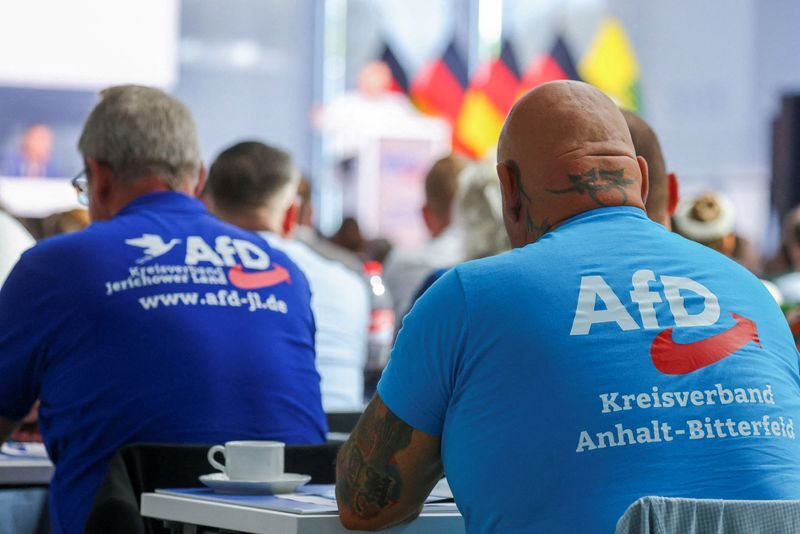
Germany’s far-right Alternative for Germany (AfD) is undergoing a significant shift in its stance on the euro and the European Union (EU), as the party gains traction and eyes a path to national power. Founded in 2013 as a movement opposed to the euro and the EU’s handling of the eurozone crisis, the AfD has long been defined by its anti-establishment and anti-immigration rhetoric. However, as the party and its far-right allies across Europe gain influence, the AfD is rethinking its roots to appear more credible and forge potential alliances.
A Shift in Strategy
The AfD’s recent strategy paper, presented by co-leader Alice Weidel, marks a notable departure from its earlier positions. Instead of advocating for Germany’s exit from the eurozone or the EU, the party now emphasizes renegotiating treaties to create a looser union. This includes proposals for an ‘opt-out’ mechanism for member states on issues like defense spending and immigration, as well as stricter budget enforcement. The paper leaves open the possibility of retaining the euro, a stark contrast to the party’s original anti-euro foundation.
This shift mirrors trends among other far-right parties in Europe. France’s National Rally, Italy’s Brothers of Italy, and Austria’s Freedom Party have all softened their eurosceptic stances as they moved closer to power. ‘Austria serves as a blueprint for the AfD,’ noted Wolfgang Schroeder, a political science professor at Kassel University. ‘It’s probably just a matter of time before they drop these positions.’
Internal Debates and External Pressures
The AfD’s evolution is not without internal tension. Younger members, like Jean-Pascal Hohm, head of the party’s youth wing, argue that hardline positions on Europe could hinder the party’s chances of forming a coalition with the conservative Christian Democrats (CDU). ‘If we were to basically cancel the common currency and everyone goes their own way again, that is completely utopian and that would also do us massive damage,’ Hohm said. He emphasizes that young Europeans increasingly identify as European, making anti-EU stances less appealing.
However, the party’s older guard remains skeptical. A resolution submitted by Hohm at a recent congress, which emphasized Europe’s shared history over economic cooperation, failed to gain sufficient support. ‘The euro issue turned out to be more controversial than we had expected,’ Hohm admitted.
Economic Realities and Political Calculations
Germany’s export-driven economy is deeply intertwined with the EU, making a departure from the bloc economically disastrous. ‘An autarky movement such as the one Hitler developed in 1933 is virtually impossible under these conditions,’ Schroeder remarked. This economic reality, coupled with growing competition from China and a less reliable United States, has led some within the AfD to argue for greater European cooperation rather than fragmentation.
Critics, however, remain wary of the party’s motives. ‘They don’t care about their roots. They just try to figure out what lies to tell the public to get elected,’ one observer noted. Others accuse the AfD of being influenced by external forces, with some suggesting ties to Russia. ‘They are maneuvering towards a coalition with CDU. Trying to show they are able to compromise,’ another commentator observed.
The Future of the AfD and Europe’s Far-Right
As the AfD continues to recalibrate its stance, its trajectory reflects broader trends in European far-right politics. Parties once defined by their opposition to the EU are increasingly adopting reformist positions as they seek power. ‘Whenever European anti-establishment parties get close to power—or actually attain it—they shift their positions,’ one analyst pointed out. ‘They will simply settle into positions slightly to the right of the traditional right-wing parties.’
For the AfD, the challenge lies in balancing its anti-establishment identity with the pragmatism required to govern. Whether this shift will broaden its appeal or alienate its core supporters remains to be seen. One thing is clear: the AfD’s evolution is a testament to the changing dynamics of European politics, where far-right parties are increasingly forced to adapt to the realities of power.

