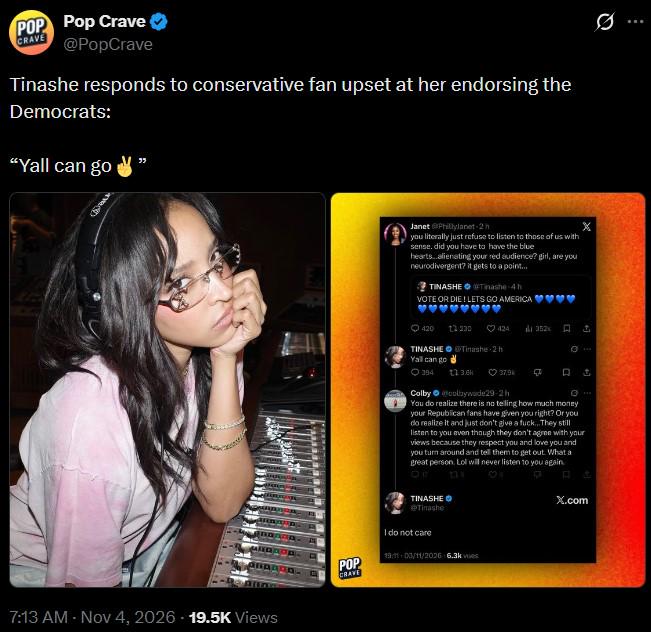
Pop star Tinashe recently made headlines after clapping back at conservative fans who took issue with her endorsement of the Democratic Party. In a blunt response, she told them, “Y’all can go ✌️,” sparking a wave of reactions across social media. The exchange underscores the growing tension between artists’ political expressions and their fans’ expectations, particularly when those views don’t align.
The Clash of Politics and Fandom
Tinashe, known for hits like Die a Little Bit and Melatonin, has never shied away from expressing her political beliefs. Her recent endorsement of the Democrats, however, drew ire from a subset of fans who identify as conservative. One fan questioned her decision, asking if she knew how much money her conservative supporters had contributed to her career. Tinashe’s response was unequivocal: “I do not care.”
This interaction highlights a broader phenomenon in pop culture: the disconnect between artists and fans who consume their work without engaging with the underlying messages or values. As one observer noted, “It’s catchy music. People don’t look any deeper than that.” Yet, when artists like Tinashe take a stand, it forces fans to confront the dissonance between their political beliefs and their admiration for the artist.
The Cognitive Dissonance of Conservative Fans
The idea of a conservative Tinashe fan seems paradoxical to many. “My brain cannot compute conservatives listening to Tinashe,” one person remarked. This sentiment echoes past instances where conservative fans of politically charged bands like Rage Against the Machine have expressed outrage over the bands’ anti-establishment messages. “Kinda like the conservatives who got mad at Rage Against The Machine for raging against the machine?” another commenter quipped.
The discussion also touched on the broader issue of media literacy. “Media literacy is at an all-time low,” one person observed, while another added, “They are masters at not being literate in the media they consume.” This lack of awareness allows some fans to enjoy an artist’s work while ignoring or dismissing its political or social context.
The Role of Identity and Politics
The conversation also delved into the intersection of identity and politics. Tinashe, a bisexual icon, has a fan base that largely aligns with progressive values. Yet, the presence of conservative fans raises questions about self-awareness and political alignment. “Self-hate is the name of the game with a lot of gay guys/queer folks,” one commenter noted, pointing to figures like Lindsey Graham and Caitlyn Jenner as examples of queer individuals who align with conservative politics.
Others highlighted the absurdity of conservatives criticizing artists for their political views. “Why are they always the first ones to cry?” one person asked. Another joked, “I hope republicans boycott her so literally nothing happens because they aren’t even her fan base.”
Tinashe’s Unapologetic Stance
Throughout the backlash, Tinashe remained unapologetic. Her response to the conservative fan—“Y’all can go ✌️”—was met with widespread support from her progressive fan base. “Artists with ethics are sexy,” one fan declared, while another added, “She’s a queen 👑.”
The incident also sparked reflections on the use of ableist language in political discourse. One commenter criticized the uptick in people using terms like “neurodivergent” as insults, while another noted, “God, MAGA is so ableist.” Tinashe’s stance, however, was clear: she would not cater to fans who opposed her values.
The Bigger Picture
Tinashe’s confrontation with conservative fans is part of a larger trend of artists using their platforms to advocate for political and social causes. While this can alienate some fans, it also strengthens their connection with those who share their values. As one fan put it, “She knows whatever conservative 'fans' she has aren't going anywhere.”
In the end, Tinashe’s response serves as a reminder that artists are not just entertainers but also individuals with beliefs and principles. Fans who cannot reconcile their politics with an artist’s message may indeed need to “go,” but for many, Tinashe’s unapologetic stance only deepens their admiration for her. As the debate continues, one thing is clear: the intersection of politics and pop culture will remain a contentious and fascinating space.